

How does learning about how my body communicates help me in moments of conflict and tension?
Preface:
This invitation is about self-accountability. The suggestions and practices are invitations for us to engage in with others we experience relative safety with and others who show up with some level of willingness to practice with us. The suggestions and practices are invitations for us to engage in with others we experience relative safety with and others who show up with some level of willingness to practice with us. These practices are not here to make others respond or show up the way we want them to. They are here to support us when responding in conflict and tension using strategies that prevent ourselves from causing, deepening, or perpetuating harm.
Intro To Embodied Awareness
I used to think that if we knew what we needed to know - knew the right words, the right theoretical frameworks, the right political standing - we could stop harm from happening. I give thanks to Amy Paulson of Healing Together for her introduction to somatic awareness, back in 2017. This introduction helped me understand how our bodies can hold tight to stories and protective responses that keep us from connecting to more of ourselves and others.
We move through life navigating compulsory institutions and systems (school, work place economy, etc.). Many of our human needs and desires for connection have long been channeled through systems that exist to maintain colonial and capitalist culture. To meet our needs for rest or connection we might have a long practice of defaulting to sites of media entertainment, subversively curated to normalize relational patterns of shame and punishment.
To my 80’s and 90’s folks - you ever go back and watch the cartoons and old shows we grew up on and cringe? We might have gotten smarter and more media literate, but best believe it’s possible that archetypes of “good vs bad,” for example, are still working through us, often causing us to punish ourselves more harshly than we do others.
Over time, we see, hear, feel the same harmful messages repeated as we navigate school, then decompress with a movie, then survive work places, then struggle to get the care we need in medical institutions, then secure food or housing via public services while dampening feelings of humiliation, etc. These messages become so deep seated, we often can’t even see or hear them.
It becomes “normal” to deprive ourselves of connection with others when “my life is in shambles.” It becomes “normal” to accept that someone in misery doesn’t deserve support because they “should have known better” or “got what they deserved.”
Even when we think we’ve unlearned messages that cause us and others harm, they continue to surface through us in relationships, social groups, or organizing spaces where we’re trying hard to show up in alignment with our new set of values or our integrity, especially when we feel our backs against the wall in the midst of conflict. We end up creating the kind of systems we’re trying to avoid or finding ourselves in similar relational patterns, person after person.
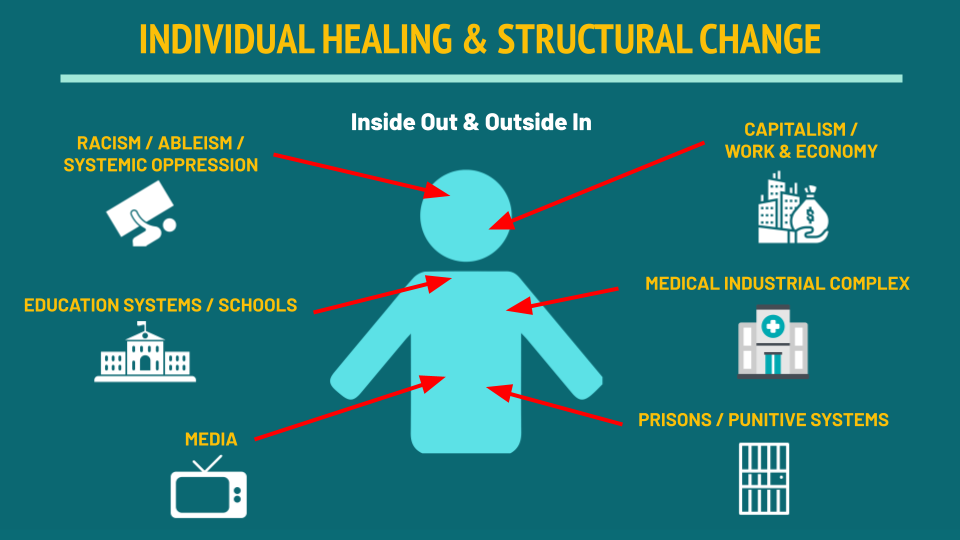
In order for us to disrupt these patterns it is not enough to change or create new systems, or to “will” ourselves into being better people in relationships. We must deepen our (individual and collective) awareness of how these patterns are triggered and what our (individual and collective) bodies are asking of us in these moments. If we are to create humanizing, connection-centered systems and relationships, the project of change cannot be isolated to our external world, it must include our internal one. And this is lifelong, nonlinear work. We are peeling back onion layers of conditioning over the years, learning ourselves and our relational needs more intimately with each era of our lives.
If you understand trigger responses and what happens to our brains and bodies when we experience a real or perceived threat, you can skip this and the next paragraph. Our bodies are generally designed to preserve the existence of our species, with variations given the neurodiversity among us. Fight, flight, freeze, and fawn responses are protective shapes we share with other animal and plant beings. When we see a bear, a snake, or stand before an audience of 300 people, we can’t help but feel our bodies automatically jump into one of these shapes. When we’re deeply frightened, we do it without thinking, without strategy - this is by design. The prefrontal cortex part of our brains (the part responsible for strategy) checks out and hands the steering wheel to our amygdala and brainstem (the parts that alert us to danger and bring us into the above protective shapes - and the parts we share with other animal kin). Give thanks for this design as it has kept our existence alive this long!
The cost of this design in our modern world is that our bodies and brains respond to perceived threat in the same way it responds to a real threat. We fight with our lovers when we feel unseen. We freeze up when called to speak in front of our classmates. Our bodies experience these as life or death situations. Our strategies, intentions, commitments, become inaccessible along with our thinking brains. There are tools we can use to access choice, agency in these moments. This starts with practicing noticing when our bodies shift into protective shapes. These can feel like clammy hands, having difficulty finding our words, sensing the urge to raise our voices or abruptly leave. Taking a beat - a breath, a break, a stretch - can help us get to a place where we can connect to what we’re feeling and decide how we really want to respond.
How Our Bodies Slip Into Patterns Of Harm
One of the ways our protective responses become hijacked by colonial and capitalist culture is by normalizing expressions of our protective responses in ways that maintain these cultures, to our own detriment, ironically.
I borrow from Tema Okun’s essay, “White Supremacy Culture,” to examine how individual and collective nervous systems move further from connection-centered responses to conflict by staying lodged in protective shapes in ways that perpetuate systemic oppression and interpersonal violence.
I summarize aspects of this culture as described in Okun’s essay in this bingo “cheat sheet” below, but I encourage you to read the linked essay above which includes antidotes to the following markers.
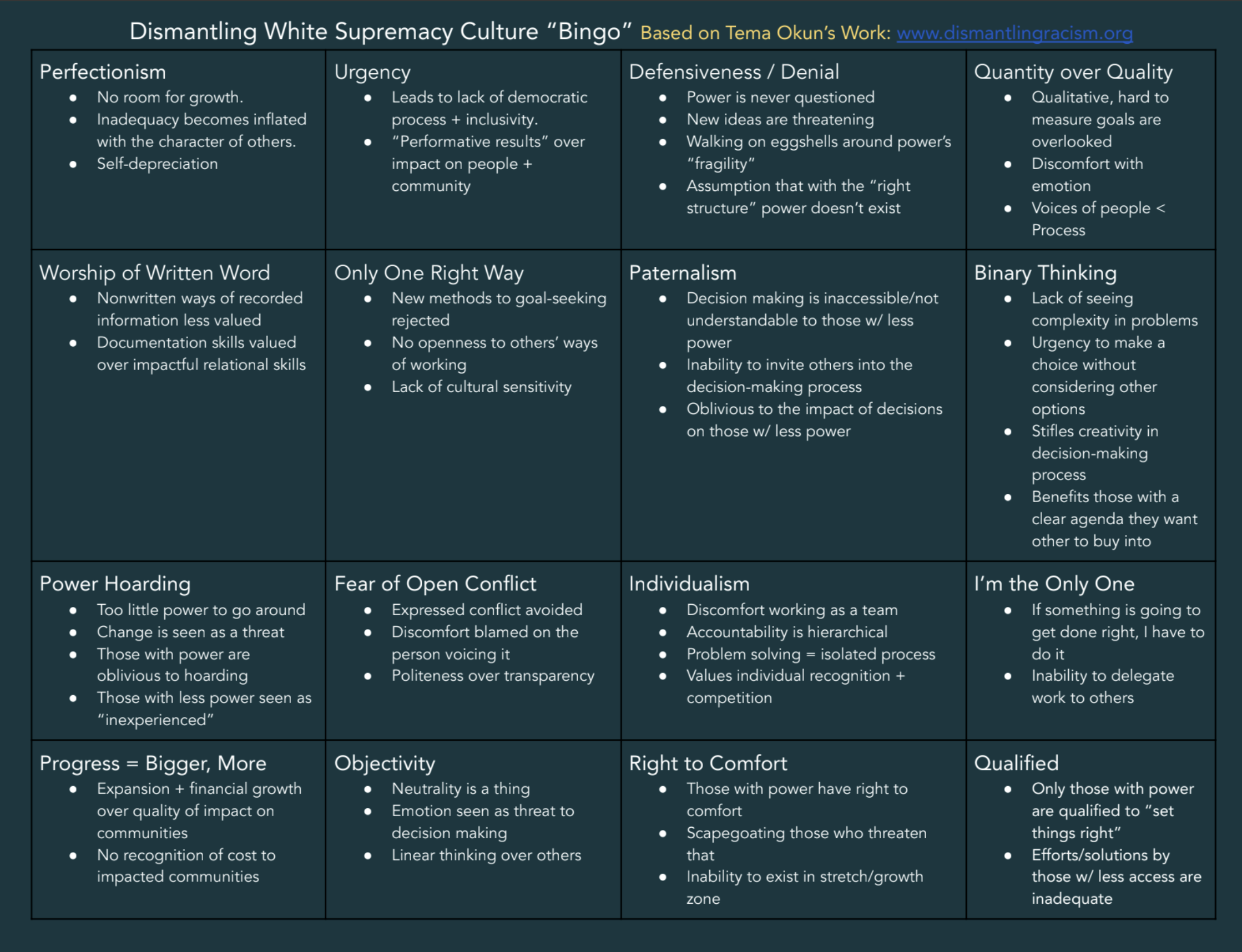
Some of these markers might feel like a given, normalized, or standard in relationships, social groups, work, or organizing spaces. This is how supremacy (or as my colleague Tanya Hernandez more accurately names it, inferiority) culture functions - under the radar, syphoning off our attempts to seek protection or connection. When whole groups stay stuck on one response, a collective nervous system attempts to survive in this protective shape. Usually, this is when individual or collective harm happens or when groups implode. We were never meant to stay in protective shapes for an extended amount of time.
Try This Exercise
Use a level 1-4 situation on a trigger scale of 1-10. Practicing at this intro level builds trust with your body as you invite it to try something that might feel new and unfamiliar.
Can you remember a time when you embodied one of these?
How did this feel like a protective response (fight, flight, freeze, fawn) in your body? What sensations did you feel?
[Ex: “My perfectionism felt like a fight response. I felt myself feeling hot and shouted at my partner for not bringing my sister a gift for her party.”]
What was your body telling you it needed?
[Note - think about what your body needed to access and not what you wanted other people to do. Ex: “I needed to feel heard” instead of “I needed them to shut up.”]
What are some ways you might imagine yourself accessing choice by honoring that need, next time you feel these sensations come over you?
[Ex: “I can take a breath and tell them I don’t feel heard. If they aren’t ready to hear me, I can tell them I need to pause the conversation. I will call my best friend or write in my journal to feel connected and heard before we try again.”]
How might your practice above be unlocking something you’re learning about yourself?
[Ex: “I realize my perfectionism comes up when I feel alone and disregarded. I’ve told them many times that gift-giving is an important cultural practice in my family. The question is deeper than ‘why couldn’t you just get a gift?’ but ‘can you understand how I really want you to be a part of my family?’”]
Ancestral* Listening Practice
Many times when our wounds get touched we may or may not be able to identify where this wound came from. We might feel an acute sensitivity around abandonment, feeling overly responsible for others’ hurts, or relationship rupture in general, for examples.
While a current situation may rightfully warrant a protective response, we might simultaneously be responding to intergenerational wounds that get touched. The (internal or external) intensity of our responses are compounded by both the present and past wound.
Sometimes we respond with intensity and are confused about why our bodies respond as such - we can’t name an origin wound or event. The origin wound could have been preverbal [before we learned to speak], inherited, or both.
When ancestral wounds get touched, we have an opportunity to accept the invitation to enter a portal, to tend to a wound that has been longing for acknowledgement and care.
You can do this exercise as a visualization or respond to the questions in a journal. Take your time with each prompt. Move slowly. If you can’t “hear” or “feel” the wound, talk to the block. Emotional blocks also hold a lot of wisdom for us.
But First, Safety
What do you need to feel safe while in this sensitive portal?
A healing object?
A call with a trusted friend to practice with?
To do this while leaning against a tree or listening to water move?
Your journal?
A call with a sponsor or trusted outreach person lined up after the exercise?
Make sure you have what you need to bring yourself back to grounding if you start to feel panic. I recommend you give yourself a full day to integrate some after care as well.
Skip this exercise for now if you’re struggling with acute mental or emotional health challenges. Check in with whoever you need to [a licensed professional, a spiritual mentor, etc.] to build capacity for emotional discomfort.
Prompts
If the wound or block had a color, texture, temperature, or shape, what would these be?
If it could communicate, what does it sound or look like when it does?
Say hello. Invite the wound or block into dialogue.
Try to hear or see it.
Ask the wound or the block these questions. The answers might be specific to your own lifetime or a story that belongs to your ancestral lineage:
Why is it here?
When did it first arrive?
What does it need?
Is there something it needs to hear?
What would it do, if it got what it needed?
Thank the wound or block for communicating with you.
Take some time to journal, draw, or sketch afterwards.
What did you learn about yourself? Your ancestral lineage/s?
What was uncovered that might be useful next time this wound surfaces?
When the wound surfaces again, what might you need to say to yourself? Ask from others?
What do your ancestors need to hear from you?
After Care
Offer yourself something tangible that aligns with how your wound needs tending.
Examples
Does it need holding? Wrap yourself tightly in a rebozo or blanket and lay bundled up for a few minutes, allowing yourself to feel held. Feel your lineage/s being held in the exact way they have been waiting to be held.
Does it need release? Go to some trees or a lake and scream. Shout. Hear your lineage/s shouting with you and tearfully, joyously, thanking you for this practice.
Does it need rest? Make yourself a warm bath and let your intuition choose what smells or sounds you need with you in this experience. Feel your lineage/s thank you for inviting the rest they are sharing with you.
Footnote
* “Ancestral” is inclusive of more than our blood lineages. We may feel ourselves connected to lineages of activists, artists, writers, teachers, care takers, land stewards, trancestors, curanderxs, etc. Lean into what feels most in alignment for you in this practice.